CEMETERIES

Do you like visiting cemeteries ? In the UK we lived very close to one and it was a popular route to take into town, with plenty of mature trees, squirrels, birds and  a large wild flower patch, yellow with dandelions in the spring.

Maybe that’s why we had no problem with buying a house that overlooked a graveyard here in France. The advantages are many. No-one will be able to develop the land and build a block of flats that blocks out our light. It is locked at night and surrounded by a high wall so thieves would find it very difficult to break into our house from behind. It is also very calm. No noisy neighbours for us!

We have a little joke that we like to tell people when they visit. The family across the road have the very un-French surname of More. So we tell visitors that we are ‘entre les morts’. We have the dead – ‘les morts’ on one side and ‘Les Mores’ on the other, so we are between the dead!

We have been very surprised to find that the average French attitude is very different. People will refuse point blank to rent or buy a home next to the dead.  The reticence to have tombs near to dwellings can be seen in the placement of cemeteries. In the UK the local church usually has a large patch of sacred ground round it, but this is rarely the case in France. Cemeteries are often far from the village and out of sight behind a high brick wall.

When I was researching the history of my grandfather’s brother who was killed in France in 1917 on the Somme, I set out to find the local cemetery in the village of Courcelette. My Great-uncle was killed at the age of 24 during a German advance. His body was found and his papers were sent to the British by the ‘enemy’. The family were told that he was buried in German Cemetery No 1. But now that graveyard has been lost.

I wanted  to see if there were any isolated German or British soldier’s graves in the local village among those of civilians. I searched maps. I searched the village website, but there was nothing, no mention of one. I knew this could not be the case – there was one in every village.

In the end I went onto Google Earth and virtually ‘walked’  along every road out of the hamlet. Along country lane, was an unusually high, neatly trimmed, hedge. I said to my husband, ‘That is where we must look.’ We visited the area and hey presto, I had found what had  not been marked on any map – the well-hidden burial ground.

If you are in France during October the cemetery is one of the places to be. At the end of the month are two weeks of half-term holidays for school children, culminating in 1st November Toussaint national holiday. Traditionally, flowers are placed on the graves for All Saints’ Day. 

I must add that the right to have a grave space is often only 30 years. If the grave is left untended and neglected the local council will repossess it and re-use it! Terrible news for family history addicts. Thus, during October far more visitors than usual come to see where their loved ones are interred.

The grave must be weeded and cleaned. People arrive with buckets and cleaning materials to give the marble headstones a good scrub. Nearly everyone comes armed with a large pot of chrysanthemums. Modern intensive plant breeding means that these ‘golden flowers’ , for that is the meaning in Greek, can now be bought in all shades of yellow, red, pink, white and purply-bronze.

The view from our window becomes more and more florid as the days pass. Families come with little children in pushchairs, couples arrive, older people with mobility problems do their duty to their sadly missed defuncts.

There was an advert on British TV quite a long time ago for an Italian product. In it a young man left a bunch of chrysanthemums on the doorstep of a girl he was hoping to impress. Grandma came home, saw the flowers and burst into tears. The viewers were supposed to know that chrysanths are associated with death in most of southern Europe. Don’t ever take a bunch as a present to anyone. They will be very taken aback.

We often take a walk around at the close of the day to appreciate  our own Chelsea flower show. Sometimes there are poignant flower arrangements. The Victorians were known for using ‘the language of flowers’ to transmit secret messages. Three vases of identical Chrysanthemums with a few red roses among them, surely spoke of ‘love’ separated by ‘death’?

Sadly, these hothouse-grown plants don’t last very long once the November weather takes hold. Sometimes strong winds wreak havoc, and pots are overturned and can be seen rolling around on their sides. Cold rain soon kills these tender plants.

The council gardeners come with a pick-up truck and any dead or dying ones are quickly removed. The big green bins are overflowing with discarded floral arrangements. However, rich pickings can sometimes be had by removing the nicest pots before the bin men arrive. Gardeners can never have enough recipients!

I feel a bit like the unofficial guardian. When, one evening at dusk a man staggered along the path, I was concerned. I was even more worried when neither I nor my husband, from the vantage point of our dining room table, had noticed him leave as night began to fall.

I had always wondered what would happen if someone fell among the tombs, unable to get up. I decided to go and check. I entered, but saw nothing, I continued, still nothing. Then right at the far end, I saw a body lying over a ground level memorial. I hurried towards him fearing the worst but was relieved to hear sobs and breathing. I encouraged him to get up and to come with me.

Fortunately, some younger family members soon arrived and took charge. I explained that I had seen him enter and indicated my house. Later on in the week someone knocked at my door. It was the man who had been in deep distress. He thanked me and sadly explained that the tomb was his wife’s who had committed suicide.

Cut price tombs! Every October time there are adverts in the papers for reductions in the price of memorials. I wonder what happens if you buy one. Does it get delivered and you store it in your garage until needed?

I heard of someone who wanted a marble table for his garden, but needed the help of half a  dozen friends to lift it into place. I wonder if the reductions in October are attractive, we could make use of the slab as a luxurious outdoor eating surface in the mean time!

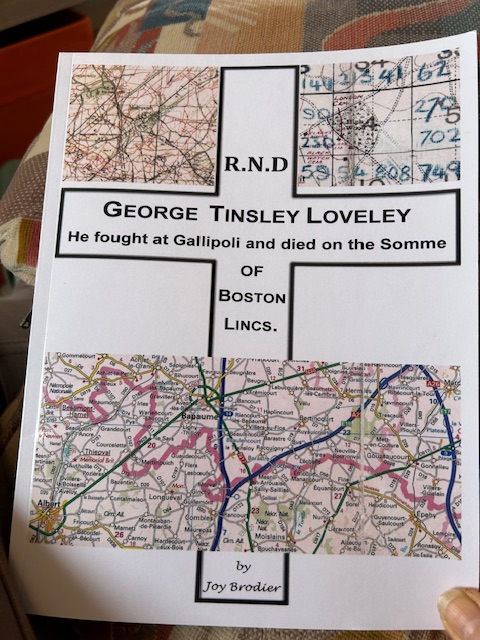
George Tinsley Loveley – ‘He fought at Gallipoli and died on the Somme.’ Available on Amazon by Joy Brodier
LAVOIRS

A great many French villages still have outdoor communal washing places – a ‘lavoir’. It won’t be long before you spot one on your travels. However, trying to describe what one looks like is very difficult as there are possibly as many designs as there are villages.

The name comes from the Latin ‘lavare ’which means to wash with a liquid. So the first pre-requisite must be water. Some ‘lavoirs’ are situated by the side of a stream, some are built next to a spring and some are built in the middle of a village joined to a fountain.

Many are very picturesque. Today they are often beautified with hanging baskets, troughs of flowers and one near Reims now contains aquatic plants and goldfish!

What fascinates me is that there are so many of them throughout France, yet none in the UK. The mayor of Birmingham was concerned that in 1914 there were still 40,000 homes without an indoor water supply out of a population of more than 630,000 indicating that the majority of the houses in that crowded industrial city had piped water. Yet in our village the ‘lavoir’ was built in 1892 meaning that at the beginning of the twentieth century it was normal for households to have no tap and for women to be washing clothes outside in river water. One of my lady students reminded me that many rural homes would have had a well and could heat water on their stove. She also added that up until the 1940’s rural people were not renowned for washing themselves very often. One bathful of heated water would suffice for all the family on a Saturday night!

The sudden appearance of many new ‘lavoirs’ in the last half of the 19th century was due to a law passed in 1851 which offered each mayor a subsidy of 30% of the cost of construction. Some mayors and councils built ‘lavoirs’ under a newly constructed town hall. While the good women laboured below, the men climbed grandiose curved stairways to meet in the council chamber above. Remember that votes for women didn’t arrive in France until 1944.

We spotted one lavoir that was a small brick building. If it had not been for the letters L A V O I R on the exterior we would have mistaken it for a garage. But in reality, this enclosed space was far more congenial for the women that used it than our one down by the river protected from the elements by just a projecting roof.

Pity the poor women of Ecueil where a fountain fed a large rectangular stone bath right in the middle of the village square.  Not a scrap of protection from sun, wind or rain was provided for those housewives. Another lavoir in our region is just an open-air ground level rim of concrete where ladies had to be on their knees to access the water, but perhaps it was a dual purpose one as often large reservoirs ‘les égayoirs’ were used to wash horses and their carts as well.

Our lavoir in Cormontreuil was said to be quite ingenious. Partially sunken barrels were tied together along the front of the washing place and each user had to climb into a barrel. Water flowing by at waist height meant that it was not necessary to bend over. I wonder if the man who thought of this idea ever tried it out? Perhaps he did, while wearing trousers, but I wonder how the voluminous skirts of the local ladies managed to fit into a barrel and how they managed to not splash any of the water on their below river-level clothes! Perhaps that is why it was the only one of its design in France!

A friend of ours arrived  in France as a young bride in 1953. While on holiday in Normandy she was intrigued to watch a woman arrive at the riverbank opposite, throw her linen on to the water, retrieve it, wring it and repeat the actions several times. All she had as a washing place was a flat piece of slate, so I suppose a lavoir would have been counted as a luxury.

The last documented use of a lavoir was in 1995. Someone asked a lady why she was using this outside washing facility. She explained that she was washing  a piece of tapestry and as she was not on mains water, she found the lavoir useful. As someone who tries to wash pillows and duvets on a regular basis, I can see that a large basin of water would be very helpful.

Also, it would be quite romantic to grow soapwort (Saponaria officinalis) flowers in the garden in order to boil up the plant to obtain a lather and to use my garden lavender as a freshening rinse before hanging my washing over my lavender bush to dry. French washerwomen were called ‘lavandiéres’ because of the close association of doing the laundry and the aromatic plant.

However beautiful your local ‘lavoir’ is now, think of the women carting wet laundry there that had been soaked overnight in washing powder made from cinders, washing the laundry with beef fat soap made with rendered fat and caustic soda, beating it with wooden paddles, hauling it over those roof rafters to drip dry. Their hands would be very rough and sore.

Give thanks that you have a washing machine and mains water and have no need to use your village lavoir however beautiful it looks today!

Joy’s Recipe

 50g dried lavender heads,

1 cup of white vinegar (supposed to brighten laundry)

1 cup water

Gently boil the lavender in the vinegar and water for 5 minutes and leave to infuse.

Strain.

Use 1/3 cup of the lavender water as the fabric softener in the washing machine.

ANOTHER GLASS OF CHAMPAGNE?

Our previous experience of Champagne was of a drink that is usually served at weddings and that it is the long, thin sweet in a packet of Maynard’s wine gums! Having come to live in the heart of the Champagne region in Reims, how has our view of Champagne changed?

We live in a suburb of the city and can see the neon lights of the commercial centre from our window, yet we are only 3 minutes drive away from our closest vineyards. In fact if I step our into the street, I can see vineyards in the distance. In the other direction our journey into town takes us past some of the most famous Champagne houses in the world, Pommery, Moet et Chandon, Veuve Clicquot and Mumm . Sometimes you can even smell the yeasty, sweet, alcoholic  aroma in the air.

Daily life is not often affected by being  so close to the vineyards, only in September when the migrant workers descend on the region to begin the harvest and spare plots of land around the city become temporary caravan sites. All the grapes are picked by hand, so as to keep the precious juice inside the skins until the moment of pressing. The normally empty hillsides and valleys of green vines become speckled with the multi-colours of the shirts and tops of the pickers and the white vans and lorries that are there to take the crop to the presses. At that time it defies belief that every row will be cleared in just 3 weeks. Anyone and everyone goes to help with the harvest, the money is good and tax free, so students, mothers, and professionals can all be found working alongside each other.

Working as  English teachers has brought both my husband and me into contact with several of the Champagne houses. I regularly have a lesson in the Veuve Clicquot headquarters  in the town centre. The lesson takes place in one of the beautifully decorated reception rooms  where honoured guests and rich clients are usually welcomed. From a huge oil painting the widow Clicquot herself keeps an eye on me. Another of my pupils is the packaging manager, so we have interesting conversations about new box designs, the mushroom shaped corks and the distinctive yellow labels.

Living in the Champagne region affects our children too.  Here the collecting of capsules, the little metal lid on top of the cork, is more common than stamp collecting. Shops sell indented trays in mock velour in which to display capsule collections. Champagne houses will bring out  special editions printed with motifs such as “French Presidents” or the “Rugby World Cup”.  Common capsules may change hands at 10 for 1 euro, but lesser known brands may be on sale for 10 euros each at the local brocante! My daughter’s collection reads like an edition of Hachette’s Guide to Champagne, Bollinger, Jacquart, Lanson, Krug, Pommery, Ruinart and Roederer. Then there are the names that only the few who are Champagne buffs would know from some of the 15,000  small producers, Diebolt Vallois, Beaumont des Crayeres, Rene Prevot and Larnaudie Hirault, G.Lagache et Fils, Veuve Forny et Fils, which makes me  wonder if there is an ”et fille” among the producers?  Our daughter will soon need a sixth capsule tray, we are collecting so many.

Do we ever drink Champagne? The answer is, “Very frequently” . It is quite hard to avoid doing so! If we are invited by friends and neighbours for aperitifs, it is not sherry that is offered but Champagne that is served, of course, in a flute and not the wide shallow glass I remember from the Babycham commercials.

Everyone has their favourite small producer and will travel out to visit him to keep their  cellar  stocked up. I went out on a visit to the vineyards with a student and we were told that we could not buy Champagne from one small producer unless we were on his existing customer list. His policy was to reserve his Champagne only for his regular clients! Fortunately my student was a buyer and we were able to purchase a bottle, after the obligatory sampling.

There cannot be many jobs outside of the Champagne industry that require the drinking of Champagne.  But that honour exists from time to time for my boss. He has a student who is a Champagne blender and who wants to learn the English vocabulary of his profession. So it was that on two consecutive afternoons just as I was leaving the office I was hailed  by my boss and invited to join in the tasting session and help with the vocabulary. The next day was our last working day before Christmas and all our teachers were treated to an end of term office party at which Champagne was of course the drink on offer.

At the end of our first six months in Reims we returned to the UK for Christmas. I felt a degree of one-upmanship  when I was able to slip into conversations, “ Last week I drank Champagne three  days in a row!”