For me, the philosophy and practice of fair-trade, ‘commerce équitable’ is a step forward in solving the problems of the world. If small growers are paid enough to support their families, buy medicines and pay school fees, their children will have a future and will not need to emigrate in order to find work. I was very involved in selling and promoting Tearcraft and Traidcraft in the UK. There are 2 groups that sell the same types of products in France and have volunteers running small shops. Fairtrade items can be found in large supermarkets but it is nowhere as big or as well-known as in the UK. The UK is Europe’s biggest Fairtrade market selling three times as much as Germany and six times as much as France. In one of our English teaching books there is a chapter on Fairtrade which I enjoy presenting. Many students, when asked, ‘Why don’t you buy more Fairtrade?’ will say, ‘because we prefer to buy French products’. (See entry for SUGAR)
EXHIBITION/CONVENTION CENTRES.
There is usually a ‘Salle d’exposition’ in medium sized and larger towns where wine fairs, environmental fairs, gardening fairs take place with professional exhibitors manning stands. Free tickets are often given away in the workplace and if you sign up to a mailing list you might be sent free tickets to the next year’s event. Other regular events are themed round pets, tourism, food, weddings, homes, antiques etc. The best one to look out for is the Salon de Chocolate!
EXAMS.
I have, in the past done some service as a paid examination invigilator. It is incredible how many ways students can think of to cheat. France has come up with quite a good idea for preventing students slipping a piece of ‘scrap’ paper with their notes on it, into the examination room. Each exam has a different colour of scrap paper. When I asked for some ‘scrap paper’ at the university – ‘brouillon’, I was offered paper in all sorts of lovely pastel shades. Yellow is used for one exam, pale blue for another and pink for a different subject, or even green. The choice is made at random to ensure that students can’t predict which colour will be used. An exam cheat in France risks being banned from taking any exam, including their driving test, for 5 years. In 2012 one hundred and forty students were punished in that manner. That is an idea that could be copied in the UK.
ENGLISHNESS.
Some things the French have observed about the English have crept into their language. Our love of custard had led to the dessert being called ‘crème anglaise’. However, I was astonished to learn that it is never eaten warm. One of my retired students was describing what he made in his soup maker. The machine could blend and heat eggs, sugar, vanilla and milk to make ‘crème anglaise’. ‘Then, while it is nice and hot you eat it?’ I asked. ‘No, you put it in the fridge to cool,’ he said. All of my students affirmed that ‘crème anglaise’ is always eaten cold. So don’t expect hot custard on your ‘tarte tatin’.
A garden with flower beds and winding paths is described as ‘un jardin à l’anglaise’. Something that we are often guilty of is ‘filer à l’anglaise’ which means to leave a gathering without saying goodbye to everyone. It’s hard enough getting used to going round everyone in the room to shake their hand or to kiss them upon arrival, without having to repeat the whole process when we leave. In our family we try to avoid it by calling out a loud, ‘Goodbye’ to everyone and giving an expansive wave of the hand. So yes, we do have a tendency to ‘filer à l’anglaise’.
DUSTBIN MEN.
There is a small footplate on the back of dustbin lorries and a vertical handrail. The dustmen jump on and off between stops like naughty schoolboys used to do on the back of red double-decker buses. Health and safety wouldn’t allow that in the UK.
DUSTBINS.
One of our French friends complained about the noisy neighbourhood that she lived in. “When they come to clean the communal bins they make so much noise.” We were astonished. “The big bins on rollers get cleaned?” we asked, trying to conceal our surprise. “Yes, of course !” she said.
In France dustmen come three times a week! One of my students was telling me about her recent holiday in Sri Lanka. She was horrified to see that people swept all their rubbish into the middle of the street where rats and flies were attracted to it. ‘And do you know?’ she said, ‘It is only collected once a week, so it smells horrible!’ I’m afraid, I kept quiet and didn’t tell her that some places in the UK have fortnightly rubbish collections!
London 2019
Day 5. Now we had three attractions that we wanted to see, all in the same road! The home of the Chelsea pensioners, the rest of the Army Museum and the Chelsea Physic Gardens. We had tickets for the later, so that was our first port of call. Walking past the home of the old soldiers, and past the Museum we arrived at 66, Royal Hospital Road. The walled south facing gardens create a microclimate where 5,000 examples of medicinal plants have been used since 1673 to teach budding apothecaries how to treat illnesses. We forget that at one time there were no pills only tisanes, tinctures and macerations of plants. The founder, Sir Hans Sloane, served as physician to the Governor of Jamaica, where he saw quinine being used to treat malaria. We also have to thank him for Cadbury’s chocolate as he observed Jamaican woman mixing cocoa with milk. He later sold the recipe to one of the Cadbury family.
At that time, remedies were more trial and error than scientifically proved. However, Alchemilla Vulgaris (see below) is sold today as a remedy for women’s problems, so they were not so far off in 1653!
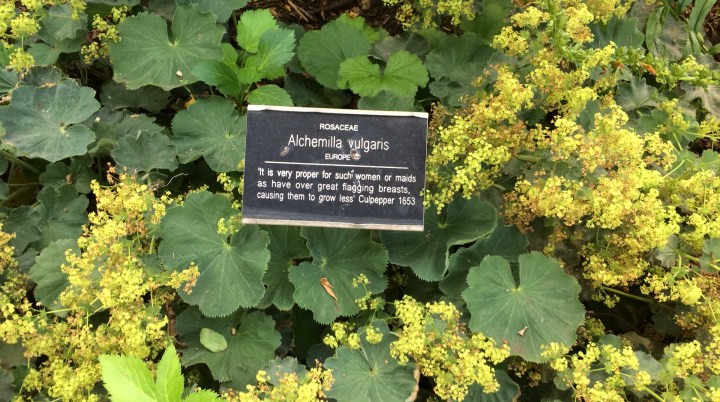
In the 1850’s Florence Nightingale included in her Crimean medicine chest powdered rhubarb and essence of ginger to relieve bowel spasms as well as quinine against malaria.
Plants that were recognised as medicinal were given the name ‘officinalis’ which historically meant that you could find them in the ‘officina’ where the monks stored and prepared the remedies. Borage, Dandelions, Ginger, Rosemary, Sage, Marshmallow and Marigolds among others all have the Latin name ‘officinalis’. Borage is the pretty blue flower that traditionally decorates a glass of Pimms.
On sale in the shop were special bottles of Beefeater London Gin.
 My family want to know why I am so interested in ‘weeds’ these days. I now have the answer for a generation who know little about wild plants but enjoy the drink of the moment – gin.
My weeds are your botanicals!
We never did get back to the Army Museum and the only part of the Chelsea Hospital we saw was their very reasonably priced teashop. It was just closing, but they kindly served us the vanilla ice-creams we needed. Vanilla comes from the seed pod of an orchid you know!
London 2019
Day 4. Do not believe comments on Trip Advisor!
I had learnt that the National Army Museum in Chelsea housed the bones of Napoleon’s last horse. Someone had commented on social media that the museum could be visited in an hour. What a travesty! The displays were well put together and thought provoking. Many exhibits were interactive making them interesting for children and adults alike. There was humour too.

My interest in plants was fed by an activity to make insect repellant from well-known herbs. I mixed shea butter with tansy and came away with a sample of cream to be tested against mosquitos at my leisure.
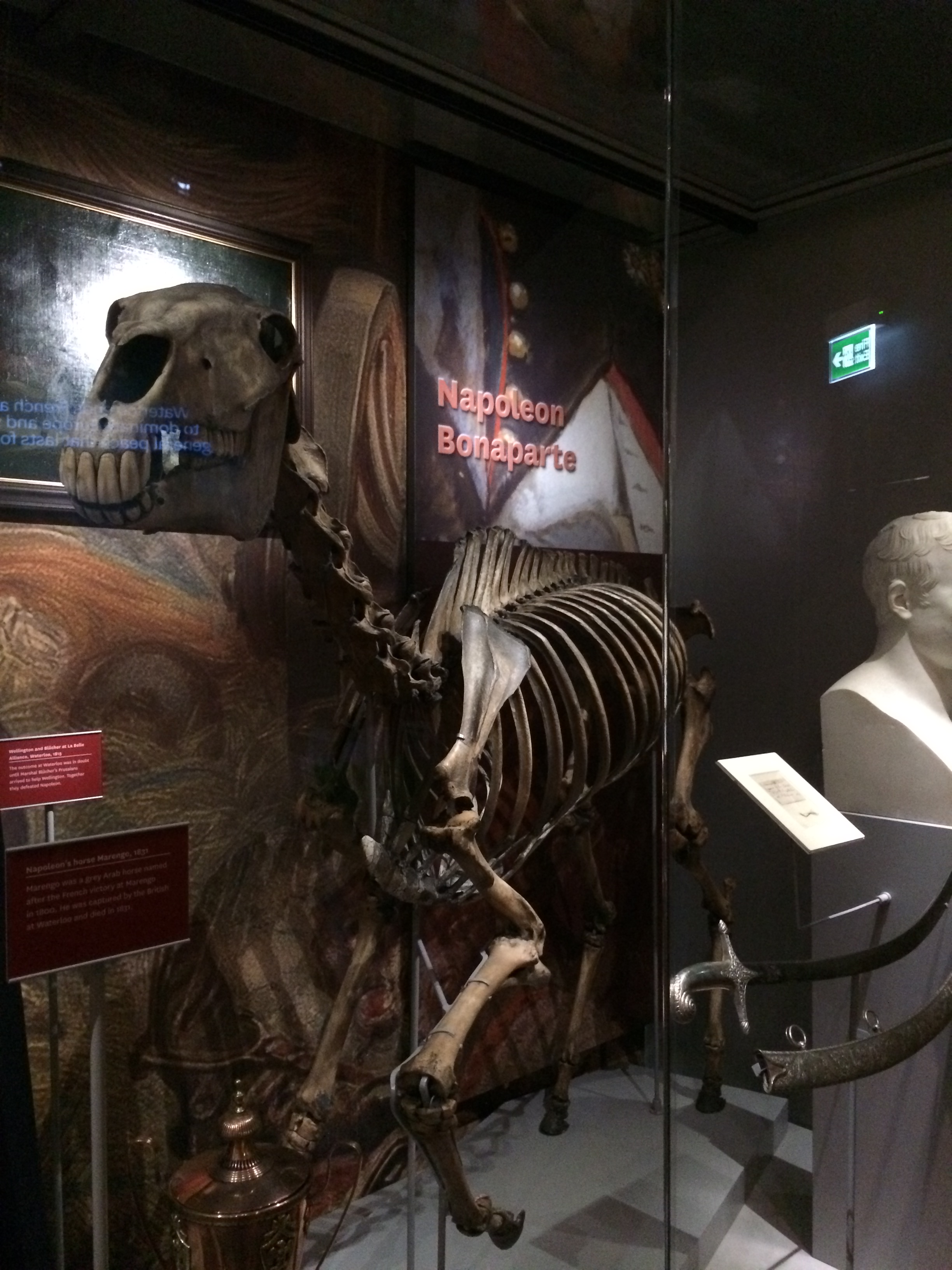
Marengo was looking a bit long in the tooth, but his bones were over 200 years old! He survived the battle of Waterloo and was brought back to England and died at the ripe old age of 34.
We could have spent a lot more time there but had an evening appointment at Lord’s to watch a game of cricket. Me? Cricket? Really? A match that only lasted 3 hours sounded acceptable. As I wrote to my daughter, I discovered many reasons to enjoy after work matches. 1) The lady’s toilets have no queues, 2) The ground is mostly filled with young business men, 3) The 6’s are celebrated by bursts of flame throwers and music, 4) There is a roving presenter who gives hampers to random spectators, 5) Picnics can include alcoholic beverages.
I would even go again!
London2019
Day 3. Why would a couple who live in France go to a French restaurant in London? We were meeting a friend and Côte Brasserie was his choice. The two course lunch menu at £12.95 was very reasonable. I had an artichoke risotto which contained plenty of vegetables. The dessert, chocolate mousse, was also very acceptable. We are great fans of Bistro Pierre too. It seems that British initiatives are providing the UK with better French restaurants than we have managed to find in France. Our friend recommended a visit to the little known Sir John Soane Museum in Holborn, 13 Lincoln’s Inn Fields, to be precise.
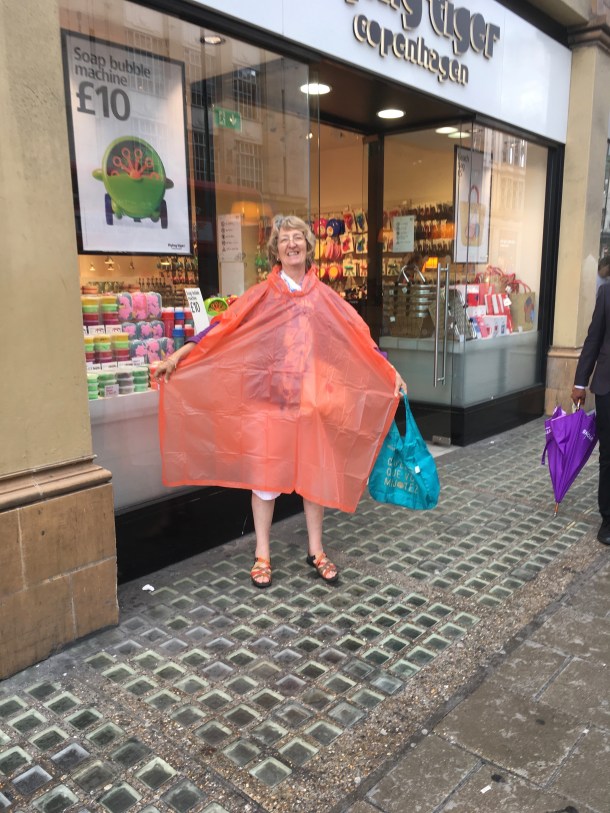
It was raining slightly, so we divide into a Flying Tiger shop. Where else can you buy colourful elastic bands, salted liquorice sweets and a rain cape?
Sir John Soane was an architect and collected a huge range of artefacts on his continental travels.
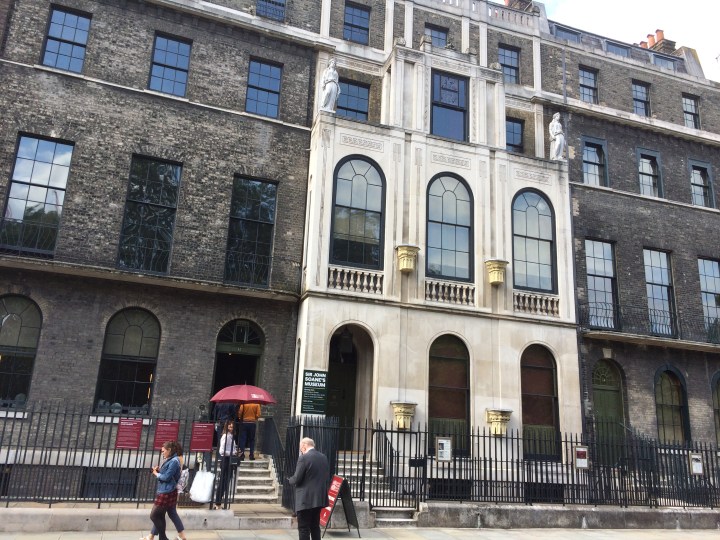
He knocked three town houses into one in order to display them. He loved letting light into buildings and in order to do so removed several floors leaving narrow walkways and balustrades, heavy with huge vases. If I had been his wife I would have protested, ‘You’re not planning to remove yet another floor are you darling?” Walls were also removed in order to replace them with up to three layers of paintings on hinges – ingenious and not to be seen in any other home. We were there at 4pm when the clever idea was demonstrated to visitors.
There were not a lot of explanatory panels, but the guardians in each room were experts in their fields and happy to answer questions. The Egyptian sarcophagus in the ceiling-less cellar was lowered into place using hooks and ropes from the four corner pillars of what was left of the walls. You only have to ask!
London 2019
Day 2. Having a theatre trip planned for the evening, it didn’t matter that we stayed in all morning while rain fell steadily. After lunch we took the tube to Westminster, crossed over the bridge in blustery wind heading for St. Thomas’s Hospital. No one was ill, but the Florence Nightingale Museum is located in a southern corner of the campus. Tickets can be booked online. There was a temporary exhibition about the Spanish ‘flu which promised to be interesting. There was plenty to see and plenty to learn about this formidable lady who refused to be confined to the norms of her day. She felt God’s call on her life to be a nurse and despite objections from her wealthy family and all around her she relentlessly pursued that calling. A bench was engraved with these words. “On February 7th 1837 God spoke to me and called me to His Service”. She found fame during the Crimea War where injured men were evacuated south to the town of Scutari. Florence organised the hospital there and put in measures to restrict the spread of disease. Men were washed on arrival, given clean hospital clothes and put into beds with clean sheets. Florence campaigned for better conditions and used her love of statistics to produce easy-to-understand graphs and diagrams that illustrated the unhealthiest times of the year. 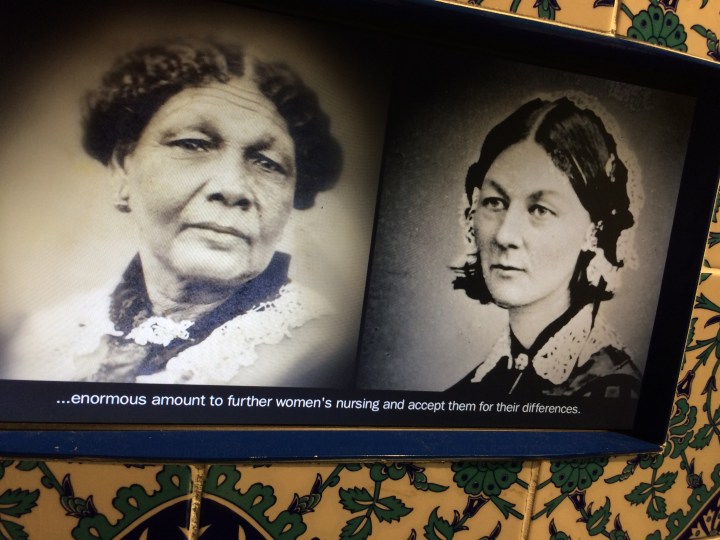
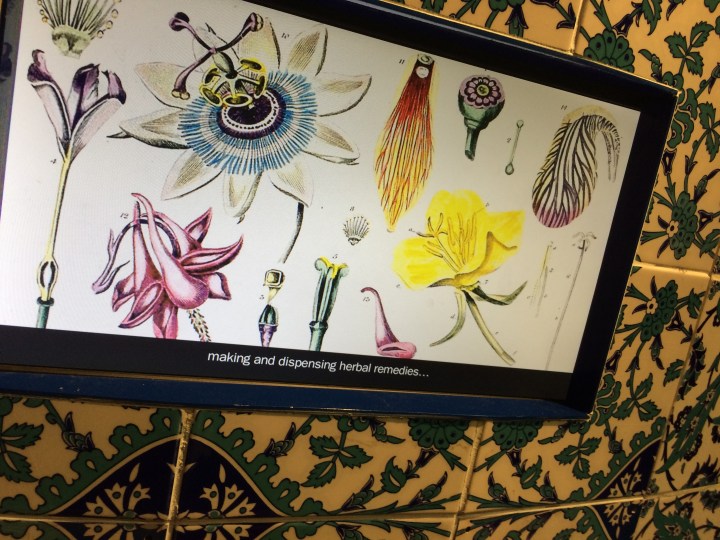 Mary Seacole also helped injured men with plant based remedies, such as using ginger to treat diarrhoea and cinnamon as an antiseptic, that she had learnt about in the West Indies.
The exhibition about the ‘Spanish ‘flu’ was a bit too visual in that it reconstructed a temporary hospital ward with a couple of beds. The origin of the illness is still being debated. It was reported in Spain as Spanish newspapers were not censored.
St. Thomas’s hospital large foyer contained a café, a clothes shop and a Marks and Spencers! We ate our packed meal in a dining area for patients and staff while we bridged the gap between our afternoon and evening activity.
We were off to see a play! The old council chamber of London’s County Hall is now used as a theatre. We were going to be members of the audience at a trial. Twelve ticket holders would even get to play the part of jury members.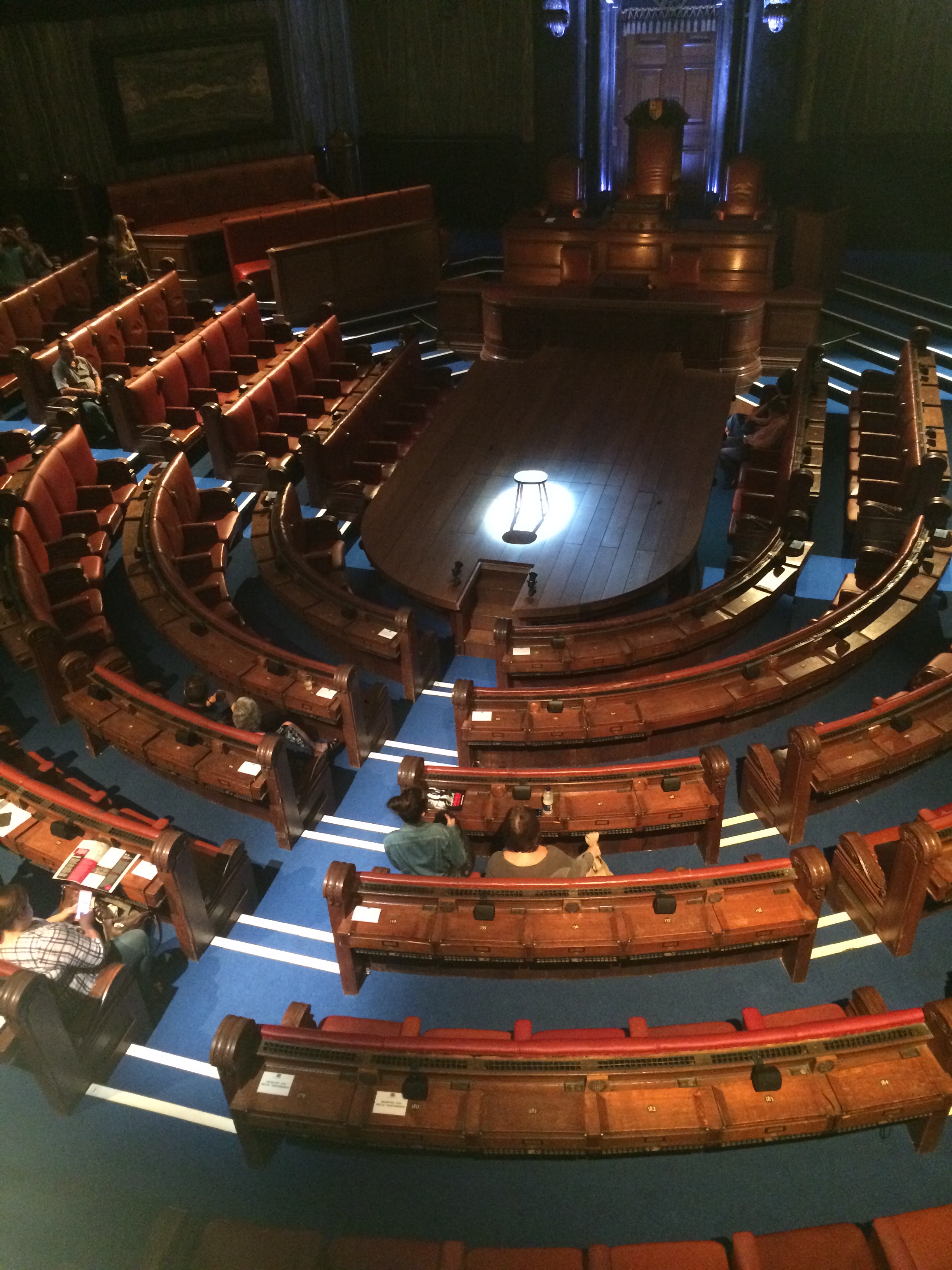
The stage was a cleverly constructed platform in the centre that also became a front room, the court and the scene of an execution. Agatha Christie wrote many thrillers that lead the reader up the garden path – this was no exception. ‘Witness for the Prosecution’ is not a title that grabs at you, but the play was certainly a thriller with typical Christie twists and turns.
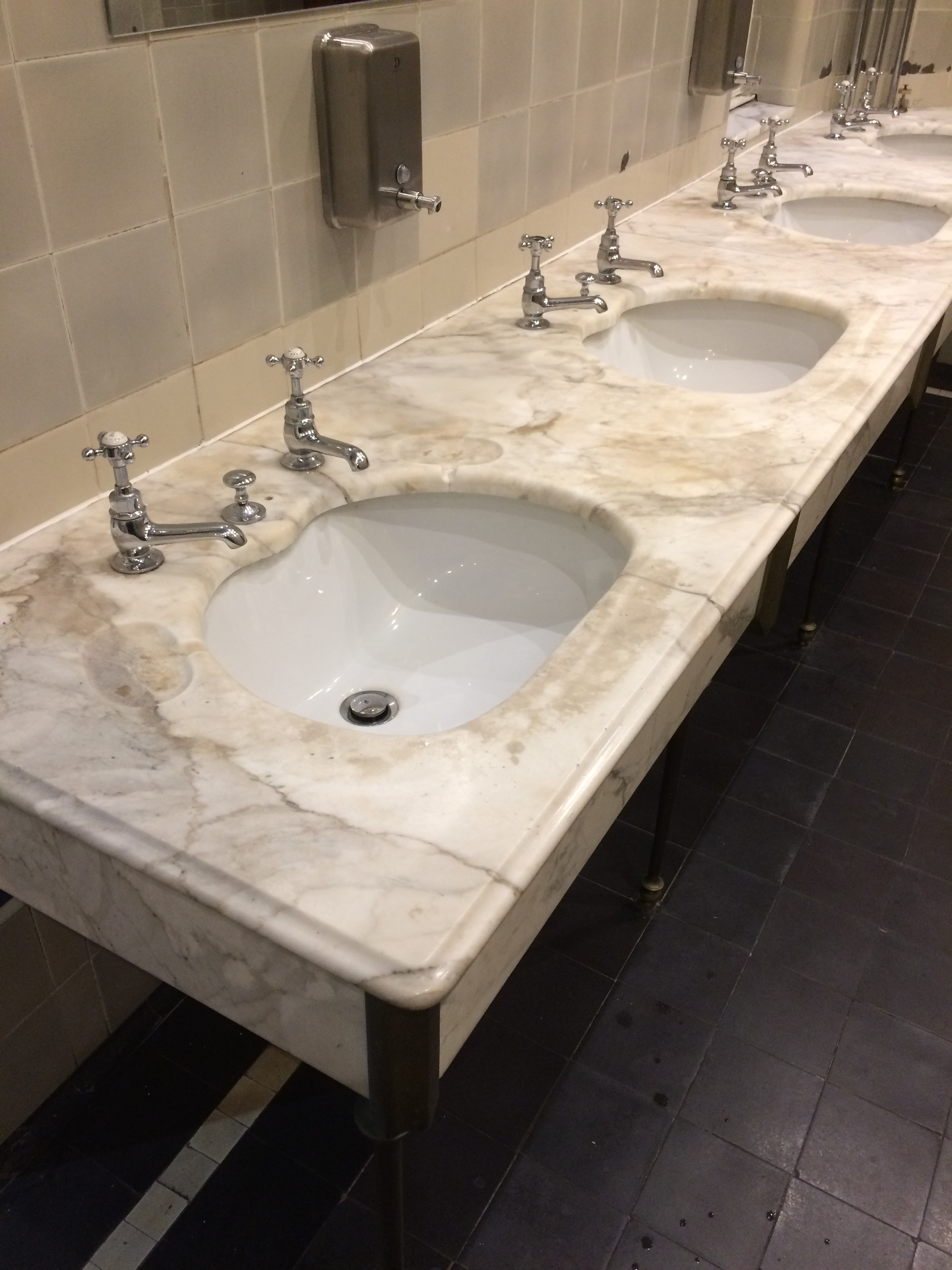
I was impressed by the marble sinks in the toilets but at least the taps were not gold plated!
 French Windows