Breakfast

A friend of ours was staying with his fiancés family. At breakfast, he asked for a cup, in which to drink his coffee. He was given a bowl. Thinking that he had not explained what he wanted, he said that he wanted a cup and not a cereal bowl. He was surprised to find that many French people drink their morning coffee or hot chocolate from a bowl. If I had had a smart phone I would have been able to add a photo here to illustrate this. A French friend was drinking tea from a cup but holding it with his first finger inside and the two adjacent fingers around the outside edge.  The handle of the cup was on the other side being completely unused. He was holding a cup as if it was a bowl. It would have been a good picture for the cover of this book.

We stayed with friends when we first arrived in France. Croissants and jam appeared on the breakfast table, but there were no plates. We were waiting to be given some, when we noticed that the children were helping themselves and not using plates. I think the theory is that croissants and French bread make so many crumbs that a plate cannot possibly contain them. At the end of the meal the plastic cloth was simply wiped clean.

Bread

French people abroad get withdrawal symptoms if they are not offered enough bread to eat. Breakfast traditionally consists of a‘tartine’, which is a long ways slice of baguette with butter and jam. In a restaurant at lunchtime a basket of bread will be put on the table. In the evening soup is accompanied by bread. I have spoken to my students about this and one sighed and said, ‘Yes, it’s true, we eat bread all the time. My father expects bread to be on the table even if the meal is pizza!’ If you host a French student, make sure you offer bread with every meal.


Bleach

Liquid bleach,  ‘Eau de Javel’ was first manufactured in the Javel district west of Paris. French people seem to use it for anything that needs cleaning. When I burnt food onto a saucepan, I was advised that ‘Eau de Javel’ would get it off. As undiluted bleach can burn a hole in stainless steel, I thought it best to ignore this advice. When a white garment gets stained, Eau de Javel seems the obvious solution. However, the slightest splash on a coloured garment leaves a pale spot. ‘Je vois que tu as utilisé de l’eau de Javel cette semaine’ = ‘Been using bleach again, I see?’, could be a useful phrase in your French vocabulary. Since living in France, I have managed to get bleached spots on at least 2 garments.


Tourists In London (5)

I had seen that the Natural History Museum  had an exhibition called ‘Dark’. We bought tickets online.

Many creatures are nocturnal, such as foxes, badgers and bats. We were encouraged to stroke a stuffed fox by the unusual sign ‘Please touch’. The writer of the newspaper article had described the bat cave exhibit as having little gusts of air that made you feel as if a bat had just flown by. Perhaps they were all asleep when I passed beneath. I had no idea that so many creatures have adapted to life in caves, such as pythons, spiders, fish, shrimps etc. I hope the 12 Thai boys just recently rescued met less wildlife than we saw.

The display about the amount  of equipment a cave diver wears was interesting in the light of that incident deep underground.

On leaving, we decided to look at the butterfly collection. The signage was non existant and so simplified that it told us nothing, Red zone, yellow zone, blue zone… past the enormous and imposing statue of Darwin, past signs to the new Darwin centre. Was Darwin the only British naturalist? Did he found the museum?

Asked various guides. We could see live butterflies in the new butterfly house for another fee. No, thanks. After wandering around and getting nowhere we learnt that the old cases of thousands of beautiful butterflies had been removed! How disappointing! Especially as the posters outside the museum feature one of my favourite  butterflies, the fist sized Owl butterfly from South America. The ‘eye’ design on its wings bears close examination. When an artist wants to make an eye look rounded and alive, he or she adds a little stroke of white to represent the light reflecting off the eye. That little flash of white doesn’t exist as part of the colours found in eyes. It is the touch that an artist knows how to use to create the impression of a rounded alive eye. Yet that little touch is found on a butterfly’s wing whose own eye is covered in stripes! How did that happen Darwin?


Tourists In London (4)

Did you know that you can visit the Bank Of England for free? Did you know you can try to lift a real gold ingot?

That’s what we did as the Bank has a museum just behind it.

Two factors had led to the successful establishment of a national bank, firstly the stability of having William and Mary come to the throne in 1688 and money being  spent on a war with France that started in the same year. Louis XIV had kept trying to expand his territories eastward but was blocked by the united provinces of the Netherlands and the Austrians.  King William’s annual expenditure totalled £2 million, but he was needing to spend £2 and a half million each year on the army alone.The war lasted 9 years. To finance the war the bank ran a lottery with prizes.

During the 18th century the bank became a bank for the government to manage the national debt. Again money was needed for wars when Louis XIV proclaimed his grandson as King of Spain and invaded the Spanish Netherlands. The Duke of Marlborough (John Churchill) won the Battle of Blenheim (among others) and Queen Anne awarded him a palace.

The bank also managed the £850 million necessary to defeat Napoleon.  Leading up to the battle of Waterloo in 1815. No wonder there is a statue to the Duke of Wellington outside the bank.

Up until then paper money could be exchanged for its equivalent in gold coins. I didn’t know that revolutionary France had declared war on Britain in 1797. A small force landed at Fishguard. A panic ensued and everyone wanted their gold. The bank’s gold reserves diminished from £16 million to £2 million. Prime Minister William Pitt ordered a temporary stop on cash payments that actually lasted for 24 years.

The First World war increased the national debt to £7 billion and we were spending £5 million pounds a day. The bank launched a 5% war loan and £2 billion was raised in just one month in January 1917.

How prosperous our countries might have been if it had not been for all these wars?

I was able to lift a gold bar (firmly enclosed in casing) and won a pen by being able to crack a safe – with Graham’s help!


Tourists in London (3)

In order to get to the Victoria and Albert Museum we walked through the western extremity of Hyde park – Kensington Gardens. We were surprised to see that we could go into Kensington Palace where numerous royals live including the Sussexes, Megan and Harry. Children were playing in their garden and it was free! Perhaps we will go back and take up their offer of a visit.

Every museum is huge. One has to have a specific aim to a visit. Mine was to check out their ceramics exhibits. My grandmother had given me a pink printed cup and saucer that look very old. There were 10 rooms of vases, plates, teapots, from around the world. My cup and saucer were most likely English so that narrowed it down a bit. Huge glass cases,  tall and narrow, with glass shelves almost reached the ceilings. I saw similar cups to mine that were made in the 16th or 17th century, so perhaps I have an antique!

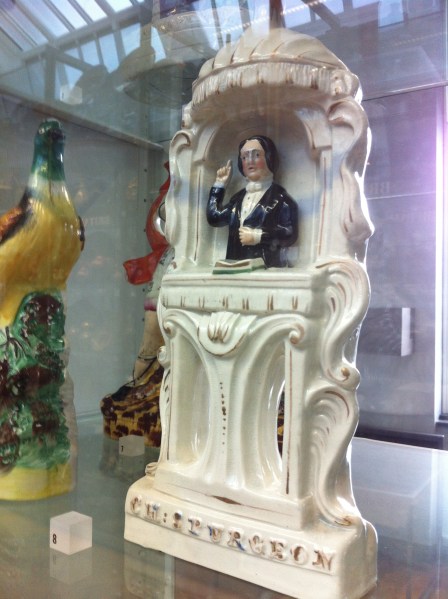
One of the many ceramics of interest was of Charles Spurgeon, born 1834, the famous Baptist preacher shown standing in a pulpit. (above)

From there we went to the Royal Albert Hall to go to a Proms concert. One of the pictures on the staircase showed Queen Victoria arriving to open the newly built  Albert Hall. In the background is the statue of her beloved late husband Albert who died at the age of 42. Victoria was heartbroken and mourned his passing for the rest of her life. She couldn’t bear to see his image, so it had been covered over with draperies for the occassion.

The first part of the concert was Gershwin’s American in Paris. The second was the  Olivier Messiaen’s Turangalila symphony. It was interesting to try to spot which instrument was making which strange sound. We decided that 75 minutes of it was possibly 60 minutes too long! As Graham said, ‘if it had been on the radio, he would have changed programmes!’ One of the strange instruments was an “ondes martenot”, designed by a Frenchman, that just a few people know how to play.


Tourists in London (2)

A while back I got in contact with a guy called Mark Hendley who does tours of the British Museum called ‘The Stones Cry Out…’ showing that the Bible is backed by archeology. We booked a tour that started at 11am and finished at 4pm. Starting with the Sumerian civilisation  of Abraham, Sarah and Lot then the Egypt of Joseph and the Hebrew slaves, Babylonian gates of bronze, Assyrian artefacts, Jericho and its fall,  Persia and the drinking dishes used by the king in the time of Daniel and Nehemiah, through to the Persians and Greeks. The highlight for Graham was the many well preserved clay tablets with tiny, neat  cuniform writing. The library of a Babylonian king was destroyed by a fire so intense that these were all baked solid and have survived the centuries. I wanted to know about Canaanite pagan gods and  how they were worshipped. When large clay pots are found that contain the burnt bones of many small children and babies, we can understand that these people made their children ‘pass thorough fire’ as sacrifices.

Have you ever seen ‘The Longest Day’ about the Normandy landings in June 1944. One of the characters was the meteorologist James Stagg. He had to hold firm and defy the Americans whose meteorologist said that the weather would be good on the Monday. Stagg predicted storms and poor visibility. There is now a West End play called ‘Pressure’ that tells the story. Apparently, Stagg’s wife was expecting their second child and had had serious complications with the first delivery due to high blood pressure. The two themes were intertwined. There were humorous moments too and it is well worth seeing.

Next door is the Saint Martin’s Theatre showing the longest running piece of theatre ever – Agatha Christie’s ‘The Mousetrap’ which has been playing for  65 years since 1952. We saw it 30 years ago and it shows no sign of coming to and end.

Black

I am constantly amazed at the lack of colour and the predominance of black in France. There is no school uniform. Nevertheless, outside any upper school, nearly every student is dressed in black. A brochure came through our door from a clothes shop. ‘K…. puts colour into your life’ it proclaimed. Opening it, I could see nothing but black clothes! When we went to buy a car we chose the only red one in the compound. It was an inspired choice. Not only has it served us faithfully for 12 years, but it can be spotted immediately in any car park, as it stands out amongst the sea of grey and black vehicles. When we went to a car show room to buy a newer model there were only grey and black models available. We waited a month and found we had the choice between a deep, dull cinnamon red and a bright shiny blue one. I think you can guess which one we bought!

Before our son’s marriage I searched every shop in the town for an outfit. In one shop, I was offered a black dress. ‘Le noir, c’est très tendance cette année’, said the assistant. ‘Black is very fashionable this year’ was the message. I explained that I was certainly not going to be wearing black for my son’s wedding! Mind you, one Autumn in the UK, I was looking for new clothes and it seemed that ‘dull’ was that year’s colour scheme.

Beef

BEEF. It might be a matter of personal opinion that British beef is best, however when a famous French chef and restaurant owner, who specializes in selling top quality beef says it, you have to sit up and take notice. This man won the Best Hamburger prize awarded by the New York Times. Yves-Marie le Bourdonnec makes some good points. He says that traditional French races like Limousins and Charolaises have been breed for working and milk production but not for meat. They are tough animals. On the other hand, the inhabitants of Loughborough should be proud of Robert Bakewell, who was born in 1725. He travelled widely, studying farming methods helping to found the 17thcentury agricultural revolution. Part of his work was breeding cattle for particular purposes. Thomas Coke, 1stEarl of Leicester, followed Bakewell’s example. His is a name I remember from school history lessons as a pioneer in agricultural progress. As a result, in Britain we have breeds especially for meat production. Our Aberdeen Angus, Galloway, Hereford and Longhorn, when grass-fed, make perfect steaks due to the fat marbling which produces tender and flavoursome beef. Yves-Marie points out that grilling and boiling require different types of meat. French meat is fine for boiling as it has plenty of collagen. Historically in France meat has been boiled in Bourguignons and ‘pots au feu’ (pots on the fire). In the UK we have been grilling and roasting meat for much longer than in France hence our nickname ‘les rosbifs’. He provoked anger when his book on beef was published, revealing that half of French beef is really old cow at the end of her life in the dairy industry. It’s true that traditionally in France the male calves go to veal production rather than being raised for beef. I loved this quote about him from a famous food critic. ‘A Frenchman against the French in the name of meat? That’s like Asterix against the Gauls. In France we say you should be brave, but not foolhardy!’